| |
|
|
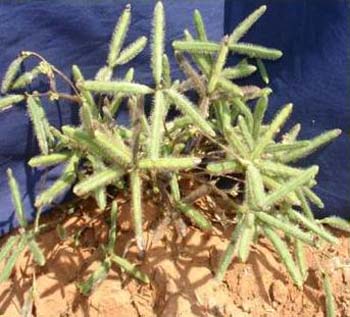
BLACKGRAM ( Vigna mungo L.)
1. SEASON AND VARIETIES
District/Season Varieties
Adipattam (June-August)
Kanchipuram, Tiruvallur, Trichirapalli,
Perambalur, Karur
Vellore, Tiruvannamalai, Dharmapuri, Pudukottai Cuddalore, Villupuram, Salem and Namakkal
Ramanathapuram, Virudhunagar, Sivagangai
Tirunelveli and Thoothukudi
Madurai, Dindigul, Theni
Erode, Coimbatore |
T 9, VBN 1, VBN 2, VBN 3, VBN(Bg) 4
T 9, VBN 1, VBN 2, VBN 3, VBN(BG) 4
CO 5, T 9, VBN 2, VBN 3, VBN(BG) 4
CO 5, VBN 1, VBN 2, VBN 3, VBN(BG) 4
CO 5, VBN 1, VBN 2, VBN 3, VBN (BG) 4 |
Puratasipattam (September-November)
Kanchipuram, Tiruvallur, Vellore, Tiruvannamalai Cuddalore, Villupuram, Dharmapuri, Salem, Namakkal
Pudukottai, Madurai, Dindigul, Theni, Ramanathapuram, Sivagangai, Virudhunagar, Thoothukudi, Tirunelveli.
Erode,Coimbatore,Tiruchirapalli,Perambalur,Karur |
VBN 1, K 1*, VBN 2, VBN 3, VBN(Bg) 4
VBN 1, VBN 2, VBN 3, VBN(BG) 4 |
Rice fallows (January)
Cuddalore, Villupuram, Thanjavur,
Tiruvarur, Nagapattinam, Trichirapalli,
Perambalur, Karur
Tirunelveli, Thoothukudi |
ADT 3
ADT 3 |
Summer (February-March)
Kanchipuram, Tiruvallur, Vellore, Tiruvan-
namalai, Cuddalore, Villupuram, Dharmapuri
Thanjavur, Tiruvarur, Nagapattinam, Tiruchi-
rapalli, Perambalur, Karur,
Pudukottai, Madurai, Dindigul, Theni, Ramana-
thapuram, Sivagangai, Virudhunagar
Tirunelveli, Thothukudi, Salem, Namakkal
Erode, Coimbatore |
ADT 5
T 9, VBN 3, VBN(Bg) 4
VBN 3, VBN(Bg) 4
VBN 3, VBN(BG) 4 |
- suitable for intercropping in cotton
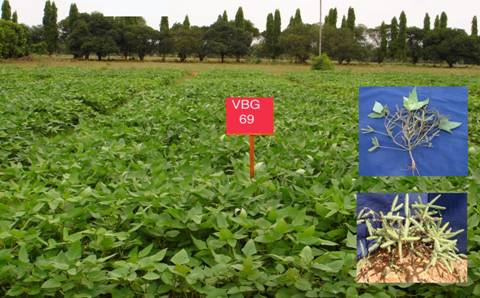
MANAGEMENT OF FIELD OPERATIONS
DESCRIPTION OF BLACKGRAM VARIETIES
Particulars |
T 9 |
CO 5 |
ADT 3 |
VBN 1 |
Parentage |
Selection from Bareilly, U.P |
Pureline selec tion from Musiri - |
Pureline selection from Tirunelveli local |
KM 1xH 76-1 |
Year of release |
1972 |
1981 |
1981 |
1987 |
50% flowering (days) |
30 - 35 |
35 - 40 |
30 - 35 |
30 - 35 |
Maturity duration (days) |
65 - 70 |
70 - 75 |
70 - 75 |
60 - 65 |
Grain yield (kg/ha) |
|
|
|
|
Rainfed |
- |
740 |
.. |
700 |
Irrigated |
1000 |
1270 |
- |
850 |
Rice fallows |
|
|
720 |
|
Height (cm) |
35 - 40 |
30 - 35 |
50 |
30 - 35 |
Clusters |
10 - 12 |
10 to 12 |
10 - 15 |
12 – 13 |
Hairiness of pods |
Glabrous |
Hairy |
Hairy |
Hairy |
Colour of grain |
Black & Dull |
Black & Dull |
Black & dull |
Black |
100 grain wt (g) |
4.0 |
5.7 |
3.6 |
5.1 |
Particulars |
ADT 5 |
K 1 |
VBN 2 |
VBN 3 |
VBN(Bg) 4 |
Parentage |
Selection from Kanpur variety |
CO 3 x US 131 |
Spontaneous mutant |
LBG 402 x LBG 17 |
CO 4 x PDU 102 |
Year of release |
1988 |
1994 |
1996 |
2000 |
2003 |
50% flowering (days) |
32 |
40 - 45 |
33 - 40 |
35 -40 |
35 – 40 |
Maturity duration (days) |
62 |
70 - 75 |
60 - 70 |
65 – 70 |
75 – 80 |
Grain yield (kg/ha)
Rainfed |
- |
707 |
750 |
775 |
780 |
Irrigated |
1323 |
- |
1000 |
825 |
900 |
Rice fallows |
|
- |
- |
|
|
Height (cm) |
20 - 25 |
30 - 35 |
25 - 35 |
25 – 35 |
40 – 45 |
Clusters |
13 - 15 |
10 - 13 |
4 - 18 |
5 - 10 |
8 – 10 |
Hairiness of pods |
Hairy |
Hairy |
Glabrous |
Hairy pods |
Glabrous |
Colour of grain |
Black |
Dull black |
Black with green tinge |
Dull black |
Black |
100 grain wt (g) |
3.6 |
5.3 |
3.83 |
4.4 |
4.8 |
1. FIELD PREPARATION
i. |
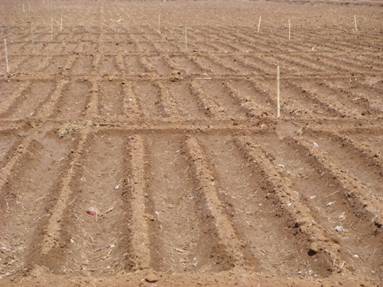
Prepare the land to fine tilth and form beds and channels. |
ii. |
Amendments for soil surface crusting: To tide over the soil surface crusting apply lime at the rate of 2t /ha along with FYM at 12.5 t/ha or composted coirpith at 12.5 t/ha to get an additional yield of about 15 - 20%. |
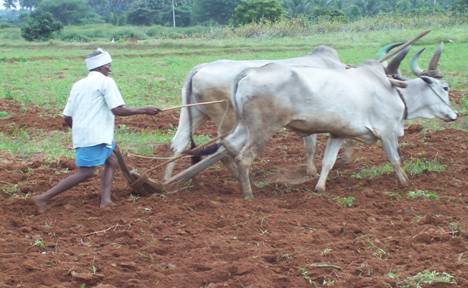
Land preparation
SEED RATE
| Quantity of seed required kg/ha |
STRAIN |
Pure crop |
Mixed crop |
T 9, CO 5, TMV 1, VBN 1, VBN 2, VBN 3, VBN (Bg) 4 |
20 |
10 |
ADT 5, TMV 1 |
|
(Rice fallows) |
25 |
.. |
Optimum plant population 3,25,000/ha
2. SEED TREATMENT
Treat the seeds with Carbendazim or Thiram @ 2 g/kg of seed 24 hours before sowing (or) with talc formulation of Trichoderma viride @ 4g/kg of seed (or) Pseudomonas fluorescens @ 10 g/kg seed. Bio control agents are compatible with biofertilizers. First treat the seeds with Biocontrol agents and then with Rhizobium. Fungicides and biocontrol agents are incompatible.
Note: Seed treatment will protect the seedlings from seed borne pathogens, root-rot and seedlings diseases.
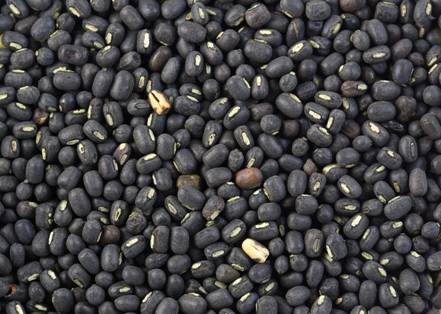
Source: http://upload.wikimedia.org/wikipedia/commons/6/6f/Black_gram.jpg
3. SEED TREATMENT WITH BIOFERTILIZER
Treat the seeds with 3 packets (600 g/ha) of Rhizobial culture CRU-7 + 3 packets (600 g/ha) of PGPR and 3 packets(600 g/ha) of Phosphobacteria developed at TNAU using rice kanji as binder. If the seed treatment is not carried out apply 10packets of Rhizobium (2000 g/ha) + 10 packets of PGPR (2000 g/ha) and 10 packets (2000 g) of Phosphobacteria with 25 kg of FYM and 25 kg of soil before sowing.
4. FERTILIZER APPLICATION
- Apply fertilizers basally before sowing.
Rainfed : 12.5 kg N + 25 kg P2O5 + 12.5 kg K2O +10 kg S*/ha
Irrigated : 25 kg N + 50 kg P2O5 + 25 kg K2O + 20 kg S*/ha
*Note : Applied in the form of gypsum if Single Super Phospate is not applied as a source of phosphorus
b) Soil application of 25 kg ZnSo4/ha under irrigated condition
5. SOWING OF SEEDS
- For irrigated crop dibble the seeds adopting 30 x 10 cm cm spacing
- For rainfed crop dibble the seeds adopting 25 cm x 10 cm spacing
6. WATER MANAGEMENT
Irrigate immediately after sowing, followed by life irrigation on the third day. Irrigate at intervals of 7to 10 days depending upon soil and climatic conditions. Flowering and pod formation stages are critical periods when irrigation is a must. Avoid water stagnation at all stages. Apply KCl at 0.5 per cent as foliar spray during vegetative stage if there is moisture stress.
Life irrigation on third day
7. SPRAYING OF DIAMMONIUM PHOSPHATE OR UREA, NAA AND SALICYLIC ACID
a. Foliar spray of Spray of NAA 40 mg/lt and Salicylic acid 100 mg/lt once at pre-flowering and another at 15 days thereafter
b. i) For rice fallow crops foliar spray of DAP 20 g/lt once at flowering and another at 15 days thereafter
ii) For irrigated and rainfed crops, foliar spray of DAP 20 g/litre or Urea 20 g/litre once at flowering
and another at 15 days thereafter.
8. WEED MANAGEMENT
i) Pre emergence application of Pendimethalin 2 litres/ha 3 days after sowing using Backpack/ Knapsack/Rocker sprayer fitted with flat fan nozzle using 500 l of water for spraying one ha. After this, one hand weeding on 30 days after sowing gives weed free environment throughout the crop period.
- If herbicides are not applied give two hand weedings on 15 and 30 days after sowing.
9. Multi bloom technology
A special technology being practiced in Pattukottai block of Tanjore district for blackgram and greengram. The soil is alluvial and rich in organic matter and nutrients. The crop is sown during early summer (Jan.-Feb.) as normal crop and fertilizer is applied as per the recommendation for irrigated crop. In addition to that, top dressing of Nitrogen is done with an extra dose of 25 to 30 kg through urea. Since pulses are indeterminate growth habit and continue to produce new flashes the top dressing will be done on 40-45 days after sowing. The crop complete its first flesh of matured pods during 60-65th day, further their second new flesh within 20-25 days. Therefore two fleshes of pods can be harvested at a time within the duration of 100 days.
RICE-FALLOWS
VARIETIES AND SEED RATE
Quantity of seed required kg/ha |
VARIETIES |
Sole crop |
Mixed crop |
CO 4, ADT 2, ADT 3, ADT 4, ADT 5, TMV 1 |
|
(Rice fallows) |
30 |
.. |
1.TIME OF SOWING
Third week of January –Second week of February
2.SOWING OF SEEDS
- For relay cropping broadcast the seeds in the standing crop 5 to 10 days before the harvest of the paddy crop uniformly under optimum soil moisture conditions so that the seeds should get embedded in the waxy mire.
- For combined harvesting areas, broadcast the seeds before harvesting the paddy crop with machinery
3. SPRAYING OF DIAMMONIUM PHOSPHATE , NAA AND SALICYLIC ACID
a. Foliar Spray of NAA 40 mg/lt and Salicylic acid 100 mg/lt once at pre-flowering and another at 15 days thereafter
b. Foliar spray of DAP 20 g/lt once at flowering and another at 15 days thereafter
4. HARVESTING
i) Picking the matured pods, drying and processing
ii) Uprooting or cutting the whole plants ,heaping ,drying and processing
Source:
www.upload.wikimedia.org/wikipedia/commons/6/6f/Black_gram.jpg
|
|
|



